
Night Marchers at Manoa Chinese Cemetery
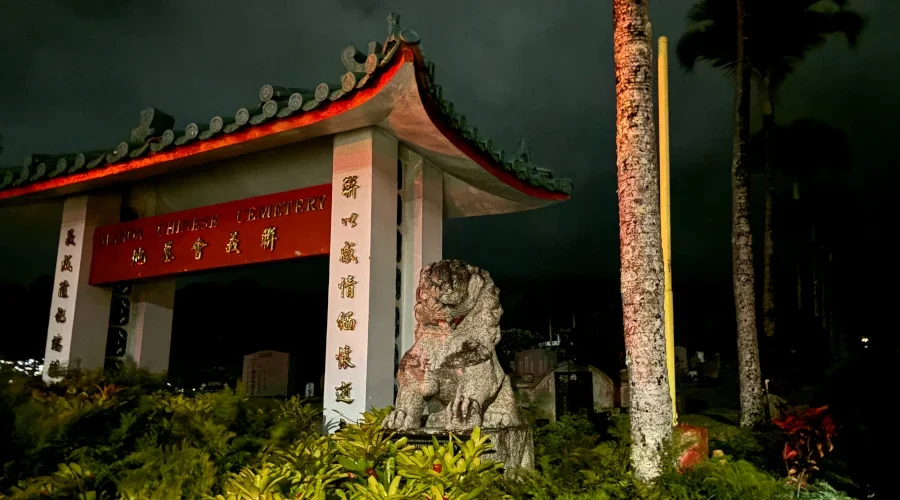
Night Marchers at Manoa Chinese Cemetery
Beneath the beauty of this verdant valley lies something deeper. Layers of history, spirituality, and unseen presence make Mānoa one of the most compelling locations in haunted Honolulu. King David Kalākaua once called Mānoa “the Valley of the Rainbow,” a place where rain and sunlight meet in quiet harmony. Surrounded by mountain ridges, the valley is known for its frequent showers and the vibrant rainbows that arc across the sky. But there’s more to the valley than beauty and rainbows.
A Sacred Valley in Hawaiian History
Just minutes from town, Mānoa has long been a desirable place to live. Hawaiian royalty once retreated here to escape the bustle of Honolulu. Queen Ka‘ahumanu, the favored wife of King Kamehameha I, spent time in the valley and eventually passed away in her home there at the age of 64.
Long before Western influence, Mānoa was considered a sacred landscape. Ancient Hawaiians believed that gods and supernatural beings inhabited the valley. Historical research suggests that as many as eight heiau once stood throughout Mānoa. These sacred sites were carefully chosen for their spiritual energy, making the valley a true wahi pana—a place of deep cultural and spiritual significance.
Feng Shui and the Energy of Mānoa
In the mid-1800s, after many of the heiau had already been destroyed, a Chinese feng shui master named Lum Ching arrived in Hawai‘i. Carrying a luo pan, a traditional feng shui compass, he explored the mountains and valleys of Honolulu in search of powerful energy.
When he reached Mānoa Valley, he discovered exactly what he was looking for.
Standing on a knoll near the back of the valley, Lum Ching aligned his compass toward the ocean and found it pointed due south. Measuring the surrounding mountains, he determined that the valley’s energy—qi—flowed perfectly into a focal point known as shui. That point was exactly where he stood.
In Chinese tradition, such a location is considered highly auspicious. If an ancestor is buried at this convergence of energy, it is believed to bring lasting prosperity to their descendants.
Recognizing the significance, Lum Ching shared his discovery with the Chinese community. Thirty-one families came together, saving months of wages, to purchase 27 acres of land. Through the Lin Yee Chung Association, they established what is now the Mānoa Chinese Cemetery—one of the most spiritually charged haunted places in Honolulu.
Night Marchers of Manoa
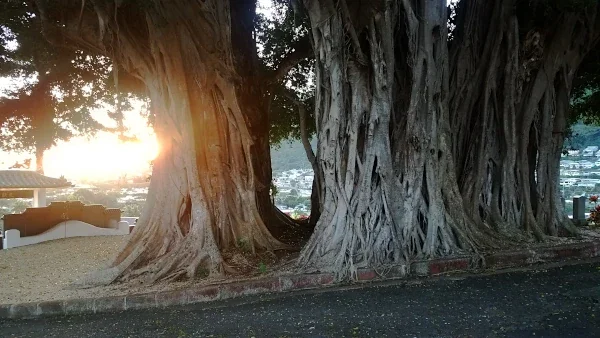
Overlooking the entire cemetery stands an imposing banyan tree with a burnt-out middle. Some say the tree was struck by lightning, others say someone deliberately set it on fire. Still others believe that the charred center is due to the tree being in the center of a night marchers’ path. On the nights of particular moon phases, the ghostly warriors are said to make their way from the top of the hill, down through Mānoa, on a path to the sea.
Haunted Honolulu awaits you
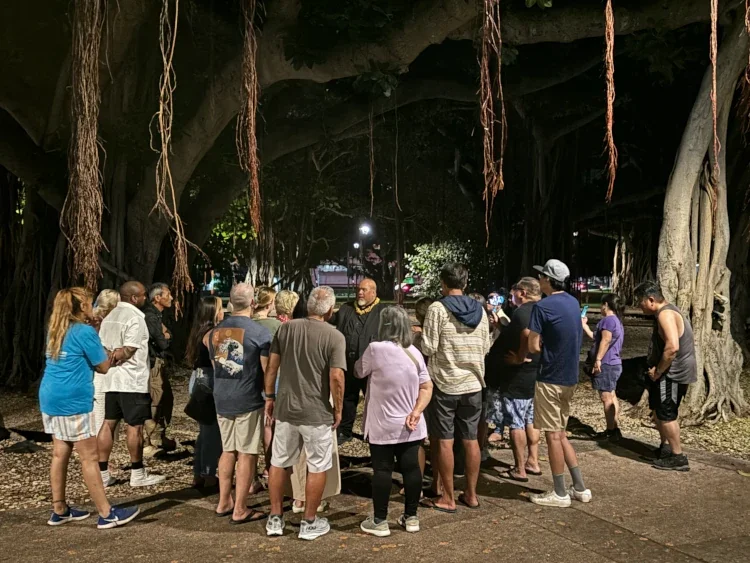
Mānoa Valley is more than a place of beauty—it is a place of energy, history, and ancestral presence. From ancient heiau to the paths of the night marchers, it remains one of the most powerful haunted places in Hawaii.
Join us on a unique experience to learn about our haunted history like the Faceless Ghost, the Kaimuki Kasha House, and Morgan’s Corner, and walk the places where the past still moves—sometimes right beside you.
